
Age-Related Eyelid Surgery
Correct sagging eyelids with upper, lower, or transconjunctival blepharoplasty at IBON Plastic Surgery. Director-led care. Book a consultation today.

Age-Related Eyelid Surgery

Medically reviewed by Dr. Ju-Chan Kim, Medical Director, IBON Plastic Surgery — trained in Plastic Surgery, Dong-A University Hospital; board-certified plastic surgeon.
Restore the tone and clarity your eyes had when you were younger. IBON Plastic Surgery's Age-Related Eyelid Surgery brightens eyes that have sagged with age, and rather than simply removing loose skin or excess fat, it addresses the functional aspects of the eye at the same time — with every case personally handled by the Medical Director from consultation through surgery.
What Is Age-Related Eyelid Surgery?
Age-Related Eyelid Surgery at IBON Plastic Surgery addresses the most common age-related changes to the eye area through three procedures: upper blepharoplasty, lower blepharoplasty, and transconjunctival lower blepharoplasty.
As collagen decreases with age, the upper eyelid gradually loses elasticity and begins to droop. This narrows the visual field, can make the eyes feel heavy or strained, and causes the eyelid skin to fold over itself, deepening the appearance of sagging. Upper blepharoplasty addresses this by removing the loosened eyelid tissue and re-anchoring the levator muscle that opens the eye, restoring both a clearer eyelid line and a more youthful appearance.
Separately, from the twenties onward, the fat beneath the eye gradually becomes more exposed and prone to bulging as the surrounding tissue changes over time. This displaced under-eye fat sags, creates wrinkling, and often takes on the appearance of a dark circle. Lower blepharoplasty addresses this through an external approach, removing sagging under-eye skin tissue while redistributing fat that has become excessive or insufficient in different areas.
Transconjunctival Lower Blepharoplasty (general procedural description, as a dedicated IBON source page wasn't available) addresses the same under-eye fat protrusion, but through an internal approach: the incision is made through the conjunctiva on the inside of the lower eyelid, leaving no visible external scar. This technique is generally reserved for patients whose primary concern is fat protrusion rather than excess skin, since it doesn't allow skin to be removed the way the external approach does — for patients with both significant excess skin and fat protrusion, the external lower blepharoplasty approach is typically more appropriate.
- Upper Blepharoplasty surgery time: about 1 hour; anesthesia: local or sleep; suture removal: 5–7 days; return to activities: ~7 days
- Lower Blepharoplasty (external) surgery time: about 1 hour; anesthesia: local or sleep; suture removal: 5–7 days; return to activities: ~7 days
- Transconjunctival Lower Blepharoplasty: no external suture removal needed; generally associated with a shorter, more discreet recovery than the external approach
- Can be combined with double eyelid surgery depending on patient request and skin condition
Advanced Age-Related Eyelid Surgery — A Personalized Approach to Aging Eyelids

Patients considering Age-Related Eyelid Surgery often describe a combination of concerns rather than a single issue: eyelids that feel heavy or genuinely restrict their vision, an eye area that looks perpetually tired despite adequate rest, or an increasingly hollow, dark, or bulging under-eye area. Some are also unsure whether their under-eye concern calls for an external incision or a scarless internal approach, and want that determined by an assessment rather than choosing in advance.
At IBON Plastic Surgery, both upper and lower blepharoplasty are approached as addressing function together with appearance. Every case is assessed and performed personally by the Medical Director, who evaluates which combination of techniques — upper, lower external, transconjunctival, or a combination with the IBON synergy add-ons described below — is warranted based on the specific pattern of aging and the balance of excess skin versus fat protrusion present.
Who Performs Age-Related Eyelid Surgery at IBON Plastic Surgery

Dr. Ju-Chan Kim, Medical Director
Board-Certified Plastic Surgeon in Korea
Dr. Ju-Chan Kim, Medical Director of IBON Plastic Surgery, personally oversees every Age-Related Eyelid Surgery case performed at the clinic. He completed his training in Plastic Surgery at Dong-A University Hospital and previously served as director at Zenith Plastic Surgery Clinic, Haneul Plastic Surgery Clinic, and The Goun Plastic Surgery Clinic. He is a member of the Korean Society of Plastic and Reconstructive Surgeons, the Korean Association for Aesthetic Plastic Surgery, the Korean Cleft and Craniofacial Association, and the Korean Association of Aesthetic Plastic Surgery Clinics. Under IBON's single representative director system, his role at consultation is to determine which combination of upper blepharoplasty, lower blepharoplasty (external or transconjunctival), and supporting techniques is appropriate for the specific pattern of skin, fat, and muscle changes present, rather than applying one standard procedure to every aging eye.
Age-Related Eyelid Surgery Options Available
| Procedure | Approach | Best Suited For |
|---|---|---|
| Upper Blepharoplasty (wide eye-to-brow spacing) | Incision follows the natural eyelid crease | Patients with more space between the eye and eyebrow |
| Upper Blepharoplasty (narrow eye-to-brow spacing) | Incision follows just beneath the eyebrow; skin fixed to bone | Patients with less space between the eye and eyebrow |
| Lower Blepharoplasty (external) | External incision; removes sagging skin and redistributes fat | Under-eye sagging involving both excess skin and fat protrusion |
| Transconjunctival Lower Blepharoplasty | Internal incision through the conjunctiva; no external scar | Fat protrusion without significant excess skin |
| Subbrow Excision + Fixation Synergy | Removes excess tissue beneath the brow and fixes it | Distant brow-to-eye gap; preserving existing eyelid crease line |
| Suprabrow Lift Synergy | Removes tissue above the brow and fixes it to the forehead muscle | Narrow eye-to-brow gap where subbrow excision would narrow it further |
| SOOF Lifting Synergy | Lifts fat above the tear-trough hollow | Volume loss correctable without broader midface lifting |
| Lateral Canthal Fixation Synergy | Tightens skin/muscle at the outer eye corner | Preventing lower eyelid sagging and eversion after surgery |
| Fat Grafting Synergy | Removes excess under-eye fat, adds fat graft volume | Significant hollowing that needs volume added back |
A closer look at how these techniques differ in practice:
Upper Blepharoplasty (wide spacing) follows the natural crease of the eyelid: the surgeon incises along the existing crease line, removes the sagging skin, and — depending on the underlying muscle — may also remove muscle tissue before suturing.
Upper Blepharoplasty (narrow spacing) is used when the eye and eyebrow sit close together. The incision follows the crease line just beneath the eyebrow, and the tissue is fixed firmly to the underlying bone before the skin is pulled taut and sutured.
Lower Blepharoplasty (external) removes sagging under-eye skin tissue and redistributes fat through a four-step process: confirming the degree of under-eye sagging, removing excess skin and redistributing fat evenly, carefully suturing the skin, and completing a smooth contour. This can also be used to create a natural "aegyo-sal" under-eye fullness at the same time as correcting sagging.
Transconjunctival Lower Blepharoplasty (general description) accesses the under-eye fat pads through an incision on the inner surface of the eyelid rather than through the skin. Because there is no external incision, this approach leaves no visible scar and is generally associated with less post-operative swelling than the external technique, though it does not allow for removal of excess skin — patients with significant skin laxity in addition to fat protrusion are typically better suited to the external approach instead.
Subbrow Excision + Fixation is offered for patients whose brow sits at a distance from the eye or who want to preserve their existing eyelid crease line. The subbrow tissue is excised and fixed to help prevent the skin from re-sagging over time.
Suprabrow Lift is the alternative for patients with a narrower eye-to-brow gap, where a subbrow excision would narrow that gap further. Tissue above the brow is removed and fixed to the forehead muscle instead.
SOOF Lifting lifts the fat pad above the under-eye hollow to correct volume loss in the tear-trough area using soft tissue alone. Lateral Canthal Fixation addresses lower eyelid sagging and helps prevent eyelid eversion by fixing skin and muscle at the outer corner. Fat Grafting removes unnecessary under-eye fat via the inner conjunctiva and adds fat graft volume back for cases with significant hollowing.
Who Is a Good Candidate for Age-Related Eyelid Surgery?
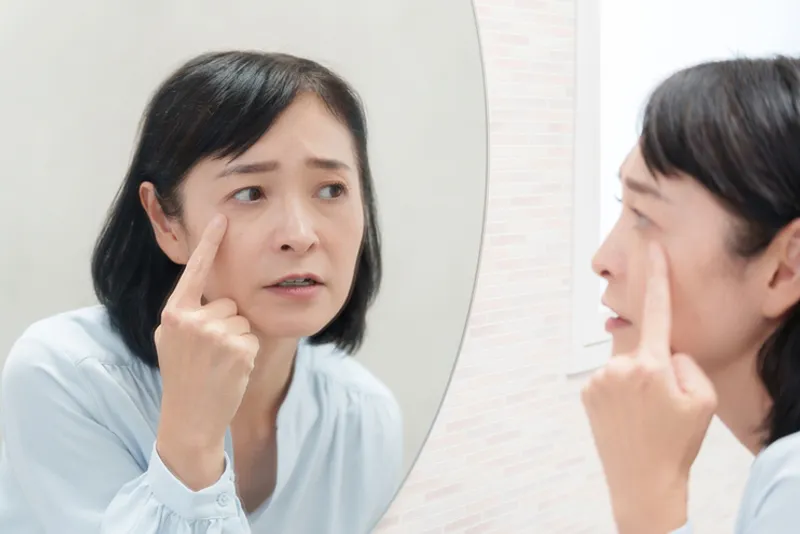
For Upper Blepharoplasty:
- Experiencing reduced vision or skin irritation caused by sagging eyelid skin
- Habitually using the forehead muscles to lift heavy eyelids, resulting in forehead wrinkles
- Eyes appear smaller than they used to due to eyelid sagging
For Lower Blepharoplasty (external):
- Dark circles are significant, alongside noticeable excess under-eye skin
- Concerned about loosened, sagging under-eye skin tissue
- Under-eye area appears uneven or bumpy in texture
For Transconjunctival Lower Blepharoplasty:
- Under-eye fat is protruding, but excess skin is minimal
- Wants to avoid any visible external scar
- Generally younger patients whose primary concern is fat bulging rather than skin laxity
What to Expect: Procedure, Recovery, and Results Timeline
| Stage | Upper Blepharoplasty | Lower Blepharoplasty (external) | Transconjunctival Lower Blepharoplasty |
|---|---|---|---|
| Anesthesia | Local or sleep anesthesia | Local or sleep anesthesia | Local or sleep anesthesia |
| Surgery time | About 1 hour | About 1 hour | Typically shorter than external approach |
| Suture removal | After 5–7 days | After 5–7 days | Not applicable (internal incision) |
| Return to daily activities | After about 7 days | After about 7 days | Generally faster, more discreet recovery |
Post-operative care: cold compresses from immediately after surgery until swelling subsides; sleeping propped up on 2–3 soft pillows rather than bowing the head or lying face-down; avoiding alcohol and smoking for at least 3 weeks; avoiding saunas or jjimjilbang for at least 3 weeks; and light walking, rather than lying down for extended periods, is helpful for reducing swelling during recovery. Complications such as bleeding, infection, inflammation, or nerve damage can occur depending on the individual, so careful adherence to post-operative guidance is advised.
Why Choose IBON Plastic Surgery for Age-Related Eyelid Surgery

- Single representative director system: every case is assessed and performed personally by the Medical Director, from the initial evaluation through to the surgery itself, without proxy surgery
- A choice of external and scarless internal techniques: the availability of both external and transconjunctival lower blepharoplasty allows the approach to be matched to whether skin, fat, or both are the primary concern
- Synergy techniques for more complex cases: SOOF lifting, lateral canthal fixation, and fat grafting are available alongside the base procedures for patients whose concerns go beyond a standard upper or lower blepharoplasty
- Integrated experience across eye plastic surgery: the Medical Director's broader work in double eyelid surgery, ptosis correction, and canthoplasty supports a coordinated understanding of overall eye appearance when planning Age-Related Eyelid Surgery
- Realistic goal-setting: the clinic's approach is built around setting achievable expectations for the degree of correction possible, rather than promising a specific outcome
Ready to Discuss Your Age-Related Eyelid Surgery Options?
Whether your primary concern is heavy, sagging upper eyelids narrowing your vision, or under-eye bulging that could be addressed with an external or scarless transconjunctival approach, the right combination of techniques starts with an assessment of your specific eye anatomy. A consultation with IBON Plastic Surgery's Medical Director gives you a clear, personalized recommendation — handled by the same surgeon from your first conversation through the procedure itself, without proxy surgery — so you can move forward with confidence in the plan chosen specifically for you.
Primary CTA: Book a Consultation
Secondary option: Contact the IBON Plastic Surgery care team directly to arrange your initial consultation and discuss whether upper, lower, or transconjunctival lower blepharoplasty may suit your needs.
Schedule a 1:1 Consultation with Dr. Ju-Chan Kim
Have questions about recovery time, surgical planning, or transparent pricing in Busan? Contact our international patient team today.
Book Consultation →