
Revision Double Eyelid Surgery
Double Eyelid Surgery | Price on Consultation
Revision Double Eyelid Surgery at IBON Plastic Surgery, Busan — 8 case types corrected by Dr. Ju-Chan Kim. Asymmetry, scarring, unraveled creases and more.

Overview of Revision Double Eyelid Surgery
Revision Double Eyelid Surgery at IBON Plastic Surgery, Busan — 8 case types corrected by Dr. Ju-Chan Kim. Asymmetry, scarring, unraveled creases and more.
Clinical Category: Double Eyelid Surgery
Lead Surgeon: Dr. Ju-Chan Kim, MD (Board-Certified Plastic Surgeon)
Consultation & Pricing: Individualized anatomical evaluation (Price on Consultation)
Double Eyelid Surgery

Medically reviewed by Dr. Ju-Chan Kim, Medical Director of IBON Plastic Surgery and a board-certified plastic surgeon in Korea.
The eye surgery that suits you is different from what suits someone else. IBON Plastic Surgery's double eyelid surgery approaches each patient's eye shape with five distinct techniques — Non-Incisional (Buried Suture), Natural Adhesion, Partial (Minimal) Incision, Incisional, and Revision — to create a more satisfying, natural-looking result, with every case personally handled by the Medical Director from consultation through surgery.
What Is Double Eyelid Surgery?
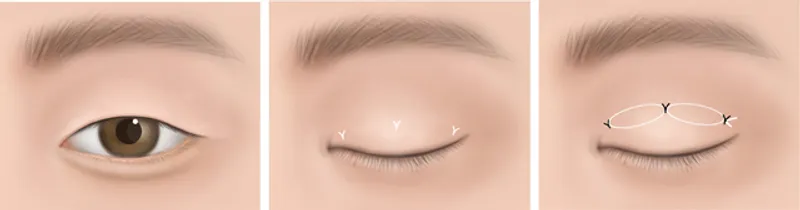
Double eyelid surgery creates a crease in the upper eyelid. At IBON Plastic Surgery, we offer five surgical approaches tailored to each patient's eyelid anatomy and aesthetic goals.
The Non-Incisional (Buried Suture) Method is the conventional approach: sutures are tied in single or multiple knots directly through the skin and underlying fascia to form the crease, without an external incision. While this avoids a visible cut, this conventional technique carries a comparatively higher chance of the crease loosening over time, since the line is held in place by the thread itself rather than by genuine tissue adhesion, and the fixation points can sometimes remain slightly visible when the eyes are closed.
Natural Adhesion Double Eyelid Surgeryis IBON's refined non- incisional technique designed to create a natural-looking eyelid crease. Using specially placed sutures through small openings, the technique aims to promote tissue adhesion and support crease formation while minimising visible scarring. The surgical approach is tailored to each patient's eyelid anatomy and desired results.
The Incisional Method opens the eyelid along the intended crease line, allowing direct removal of excess skin, muscle, and fat before suturing the dermis to the fascia that opens the eye. This fully open approach lets the surgeon adjust the eyelid line symmetrically and treat eyelids too thick or fatty for a non-incisional approach, generally producing the most durable and precisely adjustable result of the techniques offered.
Partial-Incision Double Eyelid Surgeryuses a limited incision to create an eyelid crease and allows selected tissue adjustments when needed. Rather than a continuous incision along the entire crease line, a shorter, partial incision is made — typically covering only the central portion of the eyelid — through which excess skin, fat, or muscle can be conservatively addressed. This is generally positioned as a middle-ground option for eyelids that need more correction than sutures alone can reliably provide, but not the full extent of a complete incision, offering a shorter incision and correspondingly less visible scarring than the full incisional method while still allowing some direct tissue adjustment.
For patients who have already undergone double eyelid surgery — at IBON or elsewhere — and are unhappy with the result, Revision Double Eyelid Surgery is available for patients seeking correction of unsatisfactory results from previous eyelid surgery. Because revision surgery requires identifying precisely what went wrong in the original procedure, it demands more time, effort, and surgical skill than a first-time surgery, and is performed only by a specialist with substantial relevant experience.
- Non-Incisional (Buried Suture): higher chance of the line loosening over time; fixation points may show slightly when eyes are closed
- Natural Adhesion: surgery time within about 30 minutes; recovery in about 2–3 days; line remains undetectable with eyes closed
- Partial (Minimal) Incision: shorter incision than full incisional method; moderate correction with less scarring than a complete incision
- Incisional: surgery time about 1 hour; sutures removed after 5–7 days; return to daily activities in about 5–7 days
- Revision: recommended only after the original surgery has fully healed — typically 6 months to 1 year later
Advanced Double Eyelid Surgery — A Personalized Approach to Eyelid Concerns
Patients considering double eyelid surgery are weighing more than one variable at once: whether a scarless technique is realistic for their eyelid type, how long results from a non-incisional method are likely to hold, whether a partial incision might achieve what they want without the recovery of a full incision, or how to correct a previous surgery that left an uneven or unnatural crease. These are reasonable concerns, and patients do not need to guess at an answer before their first appointment.
At IBON Plastic Surgery, every double eyelid case — from a first-time non-incisional procedure to a more complex revision — is assessed and carried out with the same standard of care. The Medical Director personally handles each stage, from the initial evaluation of eyelid skin and fat to the surgical procedure itself, so that the technique ultimately recommended reflects the individual's anatomy rather than a default approach applied broadly across patients.
Who Performs Double Eyelid Surgery at IBON Plastic Surgery

Dr. Ju-Chan Kim, Medical Director
Board-Certified Plastic Surgeon in Korea
Dr. Ju-Chan Kim, Medical Director of IBON Plastic Surgery, personally oversees every double eyelid surgery case performed at the clinic, from first-time procedures to revision surgery. He completed his training in Plastic Surgery at Dong-A University Hospital and previously served as director at Zenith Plastic Surgery Clinic, Haneul Plastic Surgery Clinic, and The Goun Plastic Surgery Clinic. He is a member of the Korean Society of Plastic and Reconstructive Surgeons, the Korean Association for Aesthetic Plastic Surgery, the Korean Cleft and Craniofacial Association, and the Korean Association of Aesthetic Plastic Surgery Clinics. Under IBON's single representative director system, his role at consultation is to identify which of the five techniques — or, for revision cases, exactly what requires correction from a prior surgery — is appropriate for each patient, rather than applying a single default approach.
Double Eyelid Surgery Options Available
| Technique | Incision Type | General Considerations |
|---|---|---|
| Non-Incisional (Buried Suture) Method | No continuous external incision; thread-only fixation | Thinner eyelid skin, minimal fat; patients prioritizing a conventional, low-cost option |
| Natural Adhesion Double Eyelid Surgery | No continuous external incision; adhesion-forming thread | Thinner eyelid skin, minimal fat; patients wanting a more durable non-incisional result than conventional buried suture |
| Partial (Minimal) Incision Double Eyelid Surgery | Short, partial incision | Moderate excess skin or fat, between non-incisional and full incisional needs |
| Incisional Method | Full incision along the crease line | Thicker eyelid skin, more fat, or looser skin; more adjustable, longer-lasting result |
| Revision Double Eyelid Surgery | Determined by prior surgery and correction needed | Correcting asymmetry or an unnatural crease from a previous double eyelid procedure |
Note: The most appropriate surgical technique depends on individual eyelid anatomy, skin condition, functional concerns, and aesthetic goals. A personalized consultation is necessary to determine the suitable approach.
A closer look at how the individual techniques differ in practice:
Non-Incisional (Buried Suture) Method forms the crease entirely through thread fixation between skin and fascia, tied in single or multiple knots. As the least invasive option, it involves minimal downtime, but carries a comparatively higher chance of the line loosening over time compared with IBON's own Natural Adhesion technique.
Natural Adhesion Double Eyelid Surgery uses strategically placed sutures through small openings to support tissue adhesion and create a natural-looking eyelid crease.
Partial (Minimal) Incision Double Eyelid Surgery (general description) uses a shorter incision, typically limited to the central portion of the eyelid, allowing conservative removal of excess tissue without the full exposure of a complete incisional approach. This can offer more precise, longer-lasting correction than sutures alone while keeping the incision — and resulting scar — smaller than the full incisional method.
Incisional Method allows three line styles depending on where the incision is placed relative to the inner corner of the eye: an in-line, starting from inside the eye and commonly suited to Asian eye shapes with a mild epicanthic fold; an out-line, starting outside the epicanthic fold for a more open eye appearance; and an in-out line, a style in between the two. The four-step process involves designing the line based on the patient's preference, incising the skin and removing the appropriate amount of skin/muscle/fat, joining the muscle that closes the eye to the fascia beneath the skin, and suturing the skin and muscle closed.
Revision Double Eyelid Surgery depends entirely on what is wrong with the original result. A loosened line is often correctable with the natural adhesion method alone if the original scarring hasn't fully hardened. A line that is too wide is released and refixed lower. A line that is too low, especially with significant skin sagging, may require the incisional method. Asymmetric lines are corrected by excising skin to restore left-right symmetry. Severe scarring is either removed directly or worked around by preserving tissue and changing its arrangement.
Who Is a Good Candidate for Double Eyelid Surgery?

For Non-Incisional (Buried Suture) or Natural Adhesion Methods:
- Eyelid skin is thin, with little sagging, and has good elasticity
- Concerned about the scarring associated with incisional surgery
- Wants minimal scarring and swelling, with a short recovery
For Partial (Minimal) Incision:
- Needs more correction than sutures alone can reliably provide
- Wants to avoid the more extensive scarring and recovery of a full incisional procedure
- Has a moderate amount of excess eyelid skin or fat
For the Incisional Method:
- Wants an especially clear, well-defined double eyelid line
- Eyelid skin is thick, with significant fat or muscle
- Eyelid is severely sagging downward
For Revision Double Eyelid Surgery:
- Left and right double eyelid lines are noticeably different
- The line feels unnatural, has faded, or has come undone entirely
- Eyes don't close comfortably after the original surgery
- The double eyelid appears too thick, prominent, or unnaturally lifted
What to Expect: Procedure, Recovery, and Results Timeline
| Stage | Non-Incisional / Natural Adhesion | Partial Incision | Incisional |
|---|---|---|---|
| Anesthesia | Local Anesthesia with Brief Sedation | Local Anesthesia with Brief Sedation | Local Anesthesia with Brief Sedation |
| Surgery time | ~30 minutes | Between non-incisional and full incisional | ~1 hour |
| Suture removal | Not typically needed | Typically required | After 5–7 days |
| Return to daily activities | ~2–3 days | Several days, less than full incisional | ~5–7 days |
Note: Recovery times vary depending on the surgical technique, individual healing response, and extent of surgery. Swelling and bruising may persist beyond the estimated return-to-activity period, and final results may take several months to stabilise.
Post-operative care applies across techniques: cold compresses from immediately after surgery until swelling subsides; sleeping propped up on 2–3 soft pillows rather than face-down or head-bent; avoiding excessive crying, hard eye-rubbing, or tightly squeezing the eyes shut; avoiding alcohol and smoking; avoiding contact lenses for about 3 weeks; light eye makeup only after about 2 weeks; and avoiding saunas or jjimjilbang for at least 3 weeks. Complications such as bleeding, infection, bruising, or nerve damage can occur depending on the individual.
Why Choose IBON Plastic Surgery for Double Eyelid Surgery
- **Surgeon-Led Care:**Every patient receives personalised care from Dr. Ju-Chan Kim, from the initial consultation through surgery and postoperative follow-up.
- Five distinct techniques available: Non-Incisional (Buried Suture), Natural Adhesion, Partial (Minimal) Incision, Incisional, and Revision surgery allow the approach to be matched to eyelid anatomy rather than a single default method.
- A Refined Approach to the Buried- Suture Technique: IBON's Natural Adhesion method is designed to support stable crease formation while creating a natural-looking eyelid crease.
- Experience across first-time and revision cases: the clinic's stated commitment includes handling both straightforward first-time surgery and more complex corrections of prior results.
- Realistic goal-setting: technique recommendations are built around achievable expectations for eyelid appearance, rather than promised outcomes.
Ready to Discuss Your Double Eyelid Surgery Options?
Choosing between non-incisional, natural adhesion, partial incision, incisional, or revision double eyelid surgery starts with understanding your own eyelid anatomy and what you're hoping to achieve, rather than choosing a technique in advance and hoping it fits. A consultation with IBON Plastic Surgery's Medical Director gives you a clear, personalized recommendation — handled by the same surgeon from your first conversation through the procedure itself, without proxy surgery — so that you can move forward with confidence in the plan chosen specifically for you, whether this is your first eyelid procedure or a revision of previous surgery.
Primary CTA: Schedule a Consultation
Secondary option: Contact the IBON Plastic Surgery care team directly to arrange your initial consultation and discuss which double eyelid surgery technique may suit your eyelid structure and goals.
Schedule a 1:1 Consultation with Dr. Ju-Chan Kim
Have questions about recovery time, surgical planning, or transparent pricing in Busan? Contact our international patient team today.
Book Consultation →