
How Under-Eye Fat Repositioning Works
Learn how under-eye fat repositioning works to reduce eye bags, smooth hollows, and refresh your appearance. Explore the procedure, recovery, and results.

How Under-Eye Fat Repositioning Works: A Patient's Guide from IBON Plastic Surgery, Busan

Understanding the Under-Eye Concern: Why Hollows and Bags Appear Together
Many people assume that under-eye bags and under-eye hollows are opposite problems — one caused by "too much" tissue, the other by "too little." In reality, they are often the same problem seen from different angles. Around the eye, fat pads sit in three compartments cushioned by a thin membrane called the orbital septum. As skin, muscle, and the septum itself lose elasticity with age, that membrane weakens and allows the fat pads to bulge forward, creating the puffy appearance below the lower lash line that people commonly call "eye bags."
At the same time, the ligament that anchors the cheek to the bone just below the eye — often referred to as the orbitomalar ligament — stays relatively fixed in place even as everything around it shifts. This creates a visible step between the bulging fat above and the flatter, sometimes hollow-looking cheek below: the tear trough. The result is a face that can look tired or aged even when a person is well-rested, simply because of how light falls across this uneven contour.
This is why simply "removing" under-eye fat rarely produces a natural result. Taking fat away without addressing the hollow beneath it can leave the lower eyelid looking flatter but still uneven, sometimes even more aged, because the shadow of the tear trough becomes more pronounced once the bulge above it is gone. This is the clinical reasoning behind under-eye fat repositioning: rather than discarding the herniated fat, the surgeon relocates it to fill the hollow it neighbors, smoothing the transition between the lower eyelid and the cheek in a single, continuous procedure.
What Under-Eye Fat Repositioning Actually Does
Under-eye fat repositioning is a lower eyelid procedure designed to correct dark, tired-looking under-eyes by redistributing existing fat rather than removing it outright. The herniated fat pockets are released and moved into the hollow of the tear trough, where they are secured to build volume in the area that has lost it. Because the treatment uses the patient's own tissue, the result tends to blend more naturally with the surrounding eyelid and cheek than an approach relying solely on injectable fillers, which sit on top of the existing structure rather than restoring it from within.
The technique is typically performed through a transconjunctival approach — an incision made on the inner surface of the lower eyelid — which leaves no visible external scar. This distinguishes it from older lower blepharoplasty methods that required an external incision just below the lash line, and it is one reason the procedure has become a common option for patients whose primary concern is volume displacement rather than excess skin.
How This Differs From Traditional Lower Blepharoplasty
Traditional lower blepharoplasty is often designed with skin and muscle removal in mind, addressing sagging or excess tissue through an external incision. Under-eye fat repositioning, by contrast, is a more targeted intervention focused specifically on volume redistribution. The two are not mutually exclusive — some patients benefit from a combined approach if both excess skin and fat displacement are present — but for patients whose lower eyelid skin remains reasonably elastic, fat repositioning alone can address the hollow-and-bulge pattern without the longer recovery and visible scarring associated with external-incision techniques.
Who Is a Good Candidate

Under-eye fat repositioning is generally suited to patients who have:
- Visible under-eye bags accompanied by a hollow or shadowed tear trough immediately below them
- Reasonably elastic lower eyelid skin, without significant excess skin that would also need trimming
- A tired or aged appearance around the eyes that is not fully addressed by skincare, sleep, or topical treatments
- No active eye infection or uncontrolled systemic condition that would affect healing
Patients whose main concern is loose or crepey eyelid skin, rather than fat displacement, may be better suited to a different procedure, such as standard lower blepharoplasty with skin trimming, or a combination approach. A thorough in-person consultation is the only reliable way to determine which category a given patient falls into, since the assessment depends on close examination of skin quality, fat volume, muscle tone, and the depth and length of the tear trough itself.
Not a Substitute for Addressing Structural Aging Alone
It's worth setting realistic expectations early: fat repositioning corrects volume distribution, but it does not halt the skin's natural aging process. Patients considering the procedure in their 40s and 50s, when skin laxity is more pronounced, may be advised to combine it with complementary treatments — such as skin-tightening technology or, in select cases, a modest skin excision — discussed during consultation on a case-by-case basis rather than applied as a default package.
How the Procedure Is Performed
At IBON Plastic Surgery, under-eye fat repositioning follows a structured process:
1. Consultation and assessment. The surgeon examines the lower eyelid's skin elasticity, fat volume, and the depth of the tear trough, and discusses the patient's goals and medical history. This is also the stage at which candidacy is determined and any complementary treatments are discussed.
2. Anesthesia. The procedure is generally performed under local anesthesia or light sleep sedation, rather than general anesthesia, which shortens recovery time and reduces overall procedure burden.
3. Fat release and repositioning. Working through a transconjunctival incision on the inside of the eyelid, the surgeon carefully releases the herniated fat pads, taking care to preserve enough volume to fill the tear trough rather than over-removing tissue. The fat is then repositioned over the hollow area and secured in its new position, typically with fine internal sutures that dissolve or are removed shortly after.
4. Closure. Because the incision is internal, no external sutures or visible scarring result from this step. Patients typically leave with minimal visible signs of having undergone a procedure, aside from expected swelling.
The procedure itself generally takes about an hour, and most patients return home the same day, without requiring an overnight hospital stay.
The Surgeon's Role and Experience
All consultations and procedures at IBON are performed personally by Dr. Kim Ju-Chan, the clinic's founder and chief director. Dr. Kim is a board-certified plastic surgeon who trained in plastic surgery at Dong-A University Hospital, one of Busan's principal teaching hospitals, and previously held director positions at several Busan-area plastic surgery clinics before founding IBON. He is a member of several recognized Korean surgical societies, including the Korean Society of Plastic and Reconstructive Surgeons and the Korean Society for Aesthetic Plastic Surgery, and has written for the public on topics including eyelid surgery safety and lower eyelid fat repositioning for middle-aged patients.
Because IBON operates on a single-director system, patients consult with, and are treated by, the same surgeon throughout the entire process — from the first evaluation through surgery and every follow-up visit. There is no substitute-surgeon arrangement, meaning the person who assesses a patient's anatomy and sets expectations is the same person performing the procedure.
What Makes IBON's Approach Distinct
IBON concentrates specifically on eyelid, brow, and forehead procedures rather than offering the broader range of cosmetic surgery found at larger, multi-specialty centers. This narrower focus allows for repeated, close attention to the anatomical variables — fat distribution, skin elasticity, and brow position — that determine how a lower eyelid procedure will look once healed. The clinic also states a policy of avoiding unnecessary treatment, recommending non-surgical or no treatment where appropriate rather than defaulting to surgery, along with a stated commitment to using genuine, appropriately sourced materials and providing structured follow-up care as part of the treatment itself rather than as an optional add-on.
Recovery and Realistic Outcomes
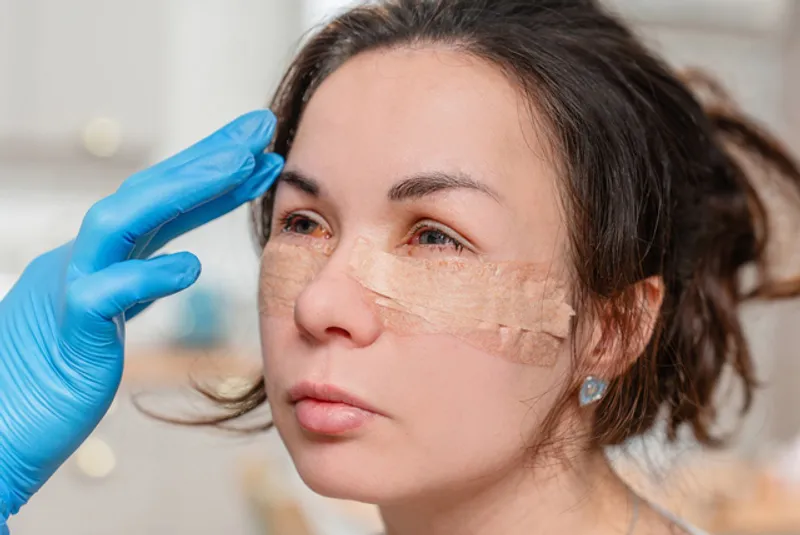
Recovery from under-eye fat repositioning is typically shorter than from more invasive lower eyelid surgery, in part because there is no external incision to heal. Patients can generally expect some bruising and swelling in the first several days, with a common recovery window of around five to seven days before returning to normal routines, though individual healing varies based on factors such as age, skin type, and how closely post-operative guidance is followed.
General Post-Operative Care Guidelines
While specific aftercare instructions should always come from the treating surgeon, patients recovering from lower eyelid procedures are commonly advised to:
- Apply cold compresses during the first 48 hours to help manage swelling
- Keep the head elevated, including while sleeping, for the first several days
- Avoid rubbing or applying pressure to the eye area
- Refrain from strenuous exercise, swimming, or activities that raise blood pressure to the face during the initial healing period
- Attend all scheduled follow-up visits so the surgeon can monitor healing and address any concerns early
It's important to approach the results with realistic expectations. Fat repositioning improves the transition between the lower eyelid and cheek and reduces the shadowed, hollow look under the eyes — it does not create a permanently unaged appearance, and results depend on each patient's underlying anatomy. As with any surgical procedure, outcomes should be discussed individually with the surgeon based on a direct physical examination, not on general expectations set by marketing materials or before-and-after photos of other patients.
Frequently Asked Questions
Is under-eye fat repositioning painful? Because the procedure is done under local anesthesia or light sedation, discomfort during the procedure itself is minimal. Some tightness or mild soreness during the first few days of recovery is common and is generally manageable with the guidance provided by the surgical team.
Will there be any visible scarring? Since the incision is made on the inner surface of the eyelid, there is no external scar from this particular technique.
How long do results typically last? Because the procedure repositions existing tissue rather than adding external material, results are generally considered longer-lasting than filler-based approaches, though the natural aging process continues over time.
A Note on Planning Your Visit
Patients traveling from outside Korea should plan around the follow-up visits that eyelid procedures require, since post-operative review is part of standard aftercare. IBON is registered as a medical institution authorized to treat international patients, and contacting the clinic in advance to coordinate consultation timing, language support, and scheduling is recommended before booking travel — particularly given that healing timelines and public holiday schedules in Korea can affect appointment availability.
Schedule a 1:1 Consultation with Dr. Ju-Chan Kim
Have questions about recovery time, surgical planning, or transparent pricing in Busan? Contact our international patient team today.
Book Consultation →